
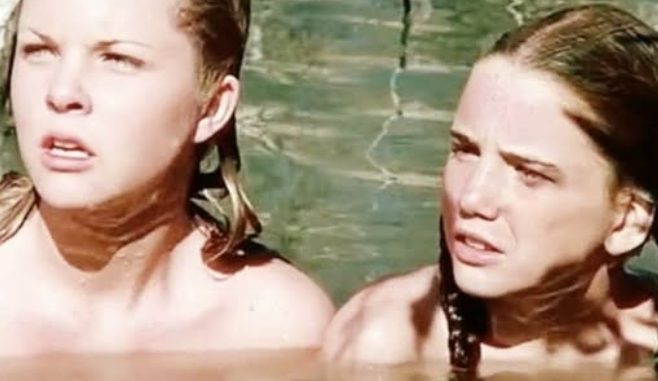
For generations of television viewers, Petticoat Junction represented a simpler kind of sitcom. The Shady Rest Hotel, the Bradley sisters, Uncle Joe, and the famous Hooterville Cannonball created a warm fictional world that felt comfortably removed from the pressures of everyday life.
But like almost every long-running television series, Petticoat Junction was filled with production changes, continuity mistakes, recast roles, and unexpected events behind the scenes.
Some of these details are easy to miss when watching the show decades later. Others became impossible to overlook once fans began examining individual episodes more closely.
The Bradley Sisters Were Not Always Played by the Same Actresses
One of the most noticeable changes involved the Bradley sisters.
Billie Jo Bradley was played by different actresses during the show’s run. Pat Woodell originally played Bobbie Jo before Lori Saunders eventually took over the role. In some scenes, production even used a stand-in when an actress was unavailable, with the character shown from behind or at a distance.
The changes went beyond simply replacing an actress.
Bobbie Jo’s personality gradually changed as well. The character began as a more serious, bookish young woman but became increasingly humorous and energetic after Saunders took over. Viewers who watch the early and later episodes closely can notice the difference.
These changes were part of the reality of producing a television series over several years.
The Hooterville Cannonball Wasn’t Always Perfectly Consistent
The Hooterville Cannonball was one of the show’s most recognizable features.
To viewers, it was simply the familiar train that connected the fictional community to the rest of the world. But production sometimes used different footage and setups, creating small inconsistencies that fans can spot.
Even the train’s identifying number was not always consistent. Different episodes and footage have shown different numbers, a detail that rarely mattered to viewers while they were caught up in the story.
There were also smaller continuity errors throughout the series.
Fans examining individual episodes have identified examples involving props, positions, clothing, shadows, and other details that change between shots. One documented example occurs in the first episode, when Uncle Joe’s hat disappears between consecutive scenes.
These mistakes are hardly unusual for television of the period. Production schedules were demanding, and audiences generally watched episodes without stopping to inspect every frame.
Bea Benaderet Was the Heart of the Series
Perhaps the most significant behind-the-scenes story involved Bea Benaderet, who played Kate Bradley.
Benaderet was central to the series during its first five seasons. When she became seriously ill, however, the production faced a problem that could not be solved with a simple recasting.
She was diagnosed with lung cancer in 1967 and had to take extended absences from the show while receiving treatment. During her absence, the story explained that Kate was away from home. Temporary mother figures, including Kate’s sister Helen and cousin Mae, were introduced to help fill the gap.
There was genuine hope that Benaderet would recover and return.
She did come back for the fifth-season finale, Kate’s Homecoming, which aired in March 1968. But her health later deteriorated, and she was forced to leave the series again.
The Show Tried to Continue Without Kate
The production team faced an unusual challenge because Kate Bradley was such an important part of the show’s identity.
Rather than immediately killing off the character, the series continued referring to Kate as being away.
Benaderet’s final involvement with the show was especially poignant. In one later episode, her voice was used while a stand-in appeared in scenes filmed from behind. The episode aired shortly after her death.
Benaderet died on October 13, 1968, at the age of 62, from lung cancer and pneumonia. Four days later, her husband, Eugene Twombly, died from a heart attack.
The loss was a devastating moment for those who knew her and for viewers who had spent years watching her as Kate Bradley.
A New Mother Figure Arrived
After Benaderet’s death, the show did not immediately disappear.
June Lockhart joined the cast as Dr. Janet Craig, who became a new maternal presence for the Bradley girls. The series continued through its final season in 1970.
The transition was understandably difficult.
Kate Bradley had been closely associated with the Shady Rest Hotel and with the show’s emotional center. Replacing that presence changed the character dynamics, even though the series attempted to preserve its familiar atmosphere.
Other Cast Losses Also Changed the Show
Benaderet was not the only cast member whose departure affected the series.
Smiley Burnette, who played railroad engineer Charley Pratt, died from leukemia in 1967 after filming for the fourth season had concluded. His absence was addressed within the story, with Floyd Smoot taking over the train’s operation.
Later, Byron Foulger, who played Wendell Gibbs, became too ill to continue appearing during the show’s final season.
These changes gradually altered the community that viewers had come to know.
The End of an Era
Petticoat Junction ended in 1970 after seven seasons.
Its final years coincided with a major change in American television. Networks were increasingly moving away from rural-themed programs in what became known as the “rural purge.” Several familiar rural shows were canceled around the same period, including The Beverly Hillbillies, Green Acres, and Mayberry R.F.D.
For fans, the ending represented more than the conclusion of another sitcom.
The show had created a fictional community filled with characters who felt familiar and dependable. Even when the production struggled with recasting, continuity mistakes, and the devastating loss of major performers, that sense of familiarity remained one of its greatest strengths.
Why the Imperfections Still Matter
Today, those mistakes and changes can make Petticoat Junction even more interesting to revisit.
A different actress playing a familiar character, a prop suddenly changing position, or an inconsistency involving the Cannonball can remind viewers that the seemingly effortless world of Hooterville was created by a large group of people working under the limitations of television production.
And behind those imperfections were real performers whose lives continued beyond the fictional world on screen.
For longtime fans, perhaps that is part of the show’s enduring charm. Petticoat Junction was never completely perfect, but it did not need to be.
The mistakes, cast changes, and difficult moments became part of its history—and decades later, they offer viewers another reason to return to Hooterville and see the beloved series with fresh eyes.
Leave a Reply