
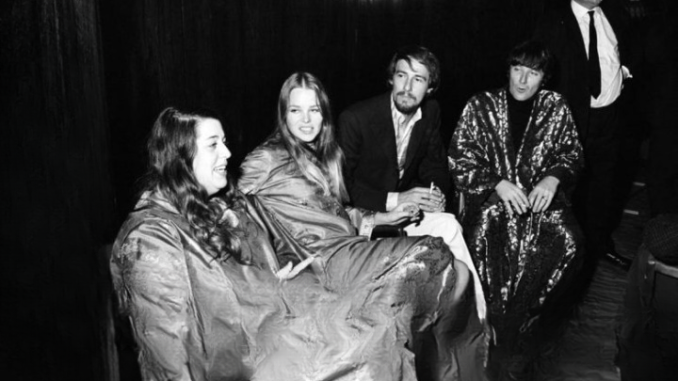
In the early 1960s, New York City was a place of constant movement.
The streets were crowded, winters could be harsh, and musicians from different backgrounds were gathering in clubs, apartments, coffeehouses, and recording studios. Folk music was developing rapidly, popular music was changing, and young performers were looking for new ways to combine traditional songwriting with modern arrangements.
Among the musicians living and working in this environment were John and Michelle Phillips.
Michelle Phillips had grown up in California, and the contrast between the West Coast environment she remembered and a cold New York winter became part of the inspiration behind one of the most recognizable songs of the 1960s.
That song was “California Dreamin’.”
Recorded by The Mamas & the Papas and released in 1965, the song became an important part of the era’s musical landscape.
Its appeal was not simply about California.
It was about longing.
It was about remembering a familiar place while being somewhere else.
And it was about the feeling of wanting warmth, comfort, and familiarity during an uncomfortable moment.
More than six decades later, the recording remains one of the defining songs associated with the 1960s.
The Story Behind “California Dreamin’”
The origins of the song are closely connected to John and Michelle Phillips.
John Phillips was an experienced musician who had become involved with folk music and performance before The Mamas & the Papas were formed.
Michelle, meanwhile, had grown up in California.
During the early 1960s, the couple were living in New York, where the colder climate was very different from the California environment Michelle knew.
That contrast helped inspire the song’s central idea.
The lyrics describe a cold winter day and the desire to be somewhere warmer.
The premise was simple, but the emotion behind it was powerful.
Many listeners could understand the feeling immediately.
You do not necessarily need to live in California to understand what it means to miss a familiar place.
A Song About More Than Weather
At first glance, “California Dreamin’” can sound like a song about escaping winter.
But its emotional meaning is broader.
The narrator is physically present in one place while mentally imagining another.
That is a familiar human experience.
People think about home when they are traveling. They remember childhood places after moving away. They imagine warm weather during winter. They think about family when they are far from home.
California became the symbol through which those feelings were expressed.
The location mattered, but the emotion was universal.
The Mamas & the Papas
The group that turned the song into a major hit was The Mamas & the Papas.
The original lineup consisted of John Phillips, Michelle Phillips, Denny Doherty, and Cass Elliot.
Their combination of voices became one of the group’s defining characteristics.
Rather than relying entirely on a single dominant vocalist, they created a layered sound in which different voices worked together.
Their music blended elements of folk, pop, rock, and vocal harmony.
That combination helped them stand out during a period when popular music was changing rapidly.
The Importance of Vocal Harmony
One reason “California Dreamin’” remains so recognizable is its vocal arrangement.
The harmonies create a sound that is both intimate and expansive.
Different voices occupy different parts of the musical arrangement, creating a layered effect. The result feels larger than a conventional solo performance while remaining personal.
This style of harmony was particularly effective for The Mamas & the Papas because the members brought contrasting vocal qualities to the group.
Their voices did not need to sound identical.
Their differences became part of the appeal.
The Song’s Musical Structure
“California Dreamin’” also benefits from a strong musical structure.
The melody is immediately memorable.
The verses establish the cold-weather setting and emotional longing, while the chorus repeatedly returns to the central desire to be somewhere else.
The arrangement builds the emotional atmosphere without becoming unnecessarily complicated.
Guitar, drums, bass, keyboards, and other instrumental elements support the performance, but the vocals remain central.
The recording demonstrates how melody, harmony, rhythm, and arrangement can work together to create a memorable song.
The Distinctive Flute Passage
One of the most recognizable instrumental moments comes near the end of the recording.
The woodwind passage adds another layer to the arrangement and contributes to the song’s distinctive identity.
Listeners may not always immediately identify the instrument, but many recognize the musical phrase as soon as they hear it.
That small detail illustrates an important part of recording history: sometimes a relatively brief instrumental contribution can become inseparable from a song’s identity.
From New York Winter to California Sunshine
The central contrast of the song is easy to understand:
Cold versus warmth.
East Coast winter versus West Coast sunshine.
Present circumstances versus an imagined destination.
That contrast helped the song connect with a broad audience.
California had already developed a powerful cultural image by the 1960s.
It represented sunshine, beaches, entertainment, opportunity, and a different way of life.
“California Dreamin’” connected that larger cultural image with something much more ordinary: the desire to escape an unpleasant winter day.
California as a Cultural Idea
By the middle of the twentieth century, California had become more than a geographic location in American popular culture.
Hollywood had helped establish its international image, while the growth of Los Angeles and other California communities attracted people from across the country.
The state became associated with entertainment, beaches, automobiles, outdoor living, and sunshine.
The song did not need to explain what California represented.
Listeners already had an idea of the destination being imagined.
That allowed California to function almost like a character in the song — a place representing warmth, familiarity, and escape.
From Songwriting to Recording
The creation of a successful recording involves more than writing lyrics and melody.
A song may begin with a basic composition, but the finished version can change significantly once singers, musicians, producers, arrangers, and recording engineers become involved.
“California Dreamin’” is a strong example of that process.
The composition provided the foundation, but the final recording was shaped by the group’s vocal arrangement and the contributions of the musicians involved in the session.
The finished track became more than a simple performance of a song.
It became a carefully constructed pop recording with a distinctive atmosphere.
Why the Song Connected With Listeners
Several elements helped “California Dreamin’” reach such a broad audience.
The melody was memorable.
The harmonies were distinctive.
The lyrics were relatively simple to understand.
Most importantly, the central emotion was universal.
Almost everyone has experienced some version of wanting to be somewhere else.
Sometimes that place is home.
Sometimes it is a favorite vacation destination.
Sometimes it is simply somewhere associated with happier memories.
The song captured that feeling in a way that required very little explanation.
The Song and the 1960s
The 1960s were a period of rapid cultural change.
Popular music was becoming increasingly adventurous. Recording technology was developing, artists were experimenting with new sounds, and different musical traditions were influencing one another.
The British Invasion had transformed the American music scene, while folk music continued to influence mainstream pop and rock.
The Mamas & the Papas emerged during this broader transformation.
Their music demonstrated that folk-inspired songwriting and sophisticated vocal arrangements could reach a large popular audience.
“California Dreamin’” became one of the clearest examples of that combination.
A Song That Outlived Its Era
Many songs become closely associated with the period in which they were created.
Some eventually feel tied to a particular decade.
“California Dreamin’” has had a different kind of life.
Its subject remains easy to understand even for listeners who were not alive during the 1960s.
A cold day.
A memory of home.
A desire for warmth.
A longing to be somewhere familiar.
Those emotions do not belong to one generation.
That universality has helped the recording remain recognizable long after its original release.
Covers and New Generations
The song’s influence can also be seen through the many artists who have recorded their own versions.
Cover versions introduce familiar songs to new audiences and can sometimes change the way listeners understand an original recording.
“California Dreamin’” has been interpreted by artists across different musical styles and generations.
Each version can emphasize a different aspect of the composition.
Some may focus on its folk qualities.
Others may emphasize its pop melody, harmony, or emotional atmosphere.
The continued interest in recording the song demonstrates the strength of the underlying composition.
More Than a Song About California
It is tempting to think of “California Dreamin’” simply as a song celebrating the West Coast.
But that interpretation misses much of what made it memorable.
California is the destination.
Longing is the subject.
The song works because it turns a specific location into a universal feeling.
The listener does not have to dream about California.
They can substitute their own place.
For one person, it might be a hometown.
For another, a childhood home.
For someone else, it might be a place connected to family, friendship, or a happier period of life.
That flexibility is one of the song’s greatest strengths.
The Legacy of The Mamas & the Papas
The Mamas & the Papas had a relatively short period at the center of popular music, but their influence has lasted much longer.
Their vocal approach helped define an important part of 1960s pop.
Their songs continue to appear on classic-music playlists, radio programs, compilations, films, television programs, and retrospectives about the era.
The group’s sound remains recognizable because the harmonies were not simply decorative.
They were central to the identity of the music.
“California Dreamin’” remains perhaps the clearest example of what made the group distinctive.
Why We Still Remember It
There is something remarkably simple about the song’s central idea.
You are somewhere cold.
You remember somewhere warm.
You close your eyes and imagine being there.
That idea does not require knowledge of the 1960s, the history of folk music, or the career of The Mamas & the Papas.
It works immediately.
That is part of the reason the song has endured.
Music can preserve a particular moment in history, but the strongest songs can also move beyond their original moment.
“California Dreamin’” does both.
It captures something about the musical and cultural atmosphere of the 1960s while expressing an emotion that remains familiar today.
A Lasting Musical Memory
More than six decades after its release, “California Dreamin’” continues to evoke a particular image: a cold day, a distant destination, and the feeling of wanting to escape somewhere warmer.
But its lasting legacy is not really about weather.
It is about memory.
It is about distance.
It is about longing for something familiar.
And perhaps that is why the song continues to connect with listeners from completely different generations.
The Mamas & the Papas created a recording that became part of the soundtrack of the 1960s.
But “California Dreamin’” ultimately became something larger than its era.
It became a musical expression of a feeling almost everyone understands — the desire to be somewhere else when the place you are in no longer feels quite right.
That is why, decades later, the opening notes can still transport listeners somewhere far away.
Maybe not necessarily to California.
But somewhere warm.
Somewhere familiar.
Somewhere they have been dreaming about.
Leave a Reply