
It started as an ordinary morning.
I stepped outside expecting nothing more than cool air, damp grass, and the familiar quiet of the yard. The night had left behind a thin layer of moisture, and the garden looked almost exactly as it did every other morning.
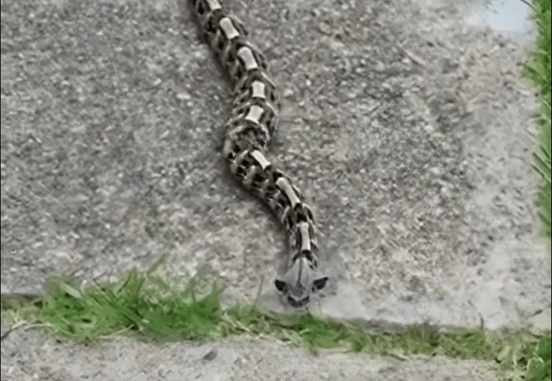
Then I noticed something near the edge of the yard.
At first, I thought it was a fallen branch.
It was partly hidden among the grass and leaves, and from a distance, it was difficult to tell exactly what I was looking at.
Then it moved.
I stopped immediately.
That was when I realized I might be looking at a snake.
Instead of getting closer, I stayed where I was and watched from a safe distance.
The encounter reminded me of something that is easy to forget when spending time outdoors: even a carefully maintained yard is still part of the natural environment.
Wild animals sometimes pass through.
Most are simply looking for food, shelter, or a route to another area.
And when an unfamiliar animal appears, the safest response usually isn’t to get closer.
It’s to give it space.
Why Snakes Sometimes Appear in Yards
Finding a snake near a home can be surprising, especially for people who don’t regularly encounter wildlife.
But yards can provide many things snakes need.
Grass offers cover.
Wood piles can provide shelter.
Gardens can attract insects and small animals.
Rock borders create hiding places.
Dense vegetation offers shade and protection.
Compost and unsecured food waste can sometimes attract rodents, which may in turn attract predators.
In other words, a landscaped yard can still function as a small part of a larger ecosystem.
A snake doesn’t understand a property boundary in the way people do.
If an area provides a useful combination of food, shelter, or a convenient path, an animal may pass through.
That doesn’t automatically mean there’s a wildlife problem.
Sometimes the animal is simply moving through the neighborhood.
My First Mistake Was Assuming I Knew What I Was Seeing
From a distance, the snake looked unfamiliar.
I immediately started wondering what species it might be.
But appearance alone isn’t always enough for accurate identification.
Color can vary.
Patterns may look different depending on age, lighting, distance, or the angle from which an animal is viewed.
Even people who are familiar with wildlife can make mistakes when trying to identify an unfamiliar snake quickly.
That’s why one of the most important rules of wildlife observation is simple:
Don’t approach an animal just to identify it.
If you don’t know what you’re looking at, keep your distance.
If it is safe to do so, a photograph taken from far away may later help a qualified local wildlife professional identify the animal.
Not Every Snake Is Dangerous
The words “snake in the yard” can immediately create anxiety.
But snakes are a normal part of many ecosystems, and not every species poses a danger to people.
Some snakes are harmless.
Some are venomous.
Others can be difficult to distinguish from similar-looking species without experience.
The species found in one region may also be completely different from those found somewhere else.
That is why location matters when identifying wildlife.
A snake that is common and harmless in one area may not even occur in another.
Instead of guessing based on a photograph or a quick visual impression, it’s safer to learn about the species that are actually found in your local region.
Why Identification Should Come Second to Safety
Learning how to recognize local wildlife can be useful.
However, identification should never require approaching, touching, cornering, or handling an animal.
Homeowners can learn about local snakes through wildlife agencies, nature organizations, educational resources, and other reputable sources.
It can be helpful to know:
- Which snakes commonly occur in your area
- Which species are venomous
- Where they are usually found
- When they are most active
- What to do if one appears near a home
- Which local professionals handle wildlife concerns
Learning this information ahead of time is much easier than trying to figure everything out while standing near an unfamiliar snake.
The Importance of Keeping Your Distance
My first instinct was curiosity.
I wanted to know exactly what I was looking at.
That’s a normal reaction.
Humans naturally want to investigate unusual things.
But curiosity can become a safety issue when it causes someone to move too close to wildlife.
A snake may interpret a person approaching it as a threat.
Even an animal that normally avoids people can become defensive if it feels trapped or cornered.
The safest approach is therefore to maintain distance.
Don’t try to touch it.
Don’t try to pick it up.
Don’t poke it with a stick.
Don’t block its path.
And don’t encourage children or pets to investigate.
If the animal has a clear way to leave, giving it space may be all that’s necessary.
What to Do When You Find a Snake
If you discover a snake in your yard, the first step is to remain calm.
Move children and pets indoors if possible.
Keep a safe distance.
Avoid making sudden movements toward the animal.
If it can leave the area on its own, allow it to do so.
A snake that has room to escape may simply disappear into nearby vegetation.
If the animal is inside your home, trapped in a confined space, or located somewhere that creates a genuine safety concern, contact an appropriate local wildlife professional or animal-control service.
You don’t have to solve the situation yourself.
Why Trying to Capture a Snake Can Increase the Risk
Some people assume that removing a snake personally is the fastest solution.
In reality, attempting to capture or kill an unfamiliar snake can bring a person much closer to the animal.
That increases the possibility of a defensive encounter.
There is also the problem of misidentification.
A homeowner may assume a snake is harmless when it isn’t, or may become unnecessarily frightened by a harmless species.
Either way, approaching it creates an avoidable risk.
When professional assistance is available, it is generally better to let trained wildlife personnel handle difficult situations.
Many Snakes Prefer to Avoid People
One of the common misconceptions about snakes is that they are actively looking for opportunities to confront humans.
Many species would rather avoid people altogether.
Humans are large, noisy, and produce vibrations.
From a snake’s perspective, a person can be something worth staying away from.
That’s why a snake may quickly disappear when it notices someone nearby.
If it has an unobstructed route away from the area, it may simply use it.
Often, the best outcome is also the least dramatic:
The person stays back.
The snake moves away.
Everyone continues with their day.
Why Even Neat Yards Can Attract Wildlife
A yard doesn’t have to look wild to provide useful habitat.
A garden with dense plants can create shade and hiding places.
A pile of firewood can shelter small animals.
Standing water can attract insects and amphibians.
Ground cover can provide protected spaces.
And areas with rodents may attract animals that naturally hunt them.
This doesn’t mean homeowners need to remove every plant or natural feature from their property.
Instead, understanding how the local environment works can explain why wildlife occasionally appears.
Making a Yard Less Attractive to Unwanted Wildlife
If snakes repeatedly appear around a home, it may be useful to look at the conditions surrounding the property.
Start by considering possible food sources.
If rodents are frequently present, predators may be attracted to the area.
Keeping garbage secured and reducing easily accessible food sources can help make a property less attractive to rodents.
Next, consider shelter.
Unused materials, piles of lumber, excessive clutter, and dense vegetation can create hiding places for many animals.
Keeping frequently used areas organized can reduce some of these opportunities.
However, the goal shouldn’t be to eliminate wildlife completely.
A healthy outdoor environment will always contain animals.
The goal is simply to reduce unnecessary attractants around places where people and pets spend time.
Rodents Can Be Part of the Bigger Picture
Many snake species eat rodents and other small animals.
That means a snake appearing on a property may sometimes be connected to the presence of prey.
Instead of asking only, “How do I get rid of this snake?” homeowners can ask broader questions.
Why is it here?
What might it be finding?
Where could it be sheltering?
Are there food sources nearby?
Are there areas around the property that provide convenient hiding places?
Understanding those factors can be more useful than simply removing one animal.
Teaching Children About Snake Safety
Children are naturally curious about animals.
A snake can therefore become an immediate source of fascination.
Parents and caregivers can teach children a simple rule:
If you see a snake, don’t approach it.
Children don’t need to be frightened of wildlife.
They need to understand boundaries.
Wild animals can be interesting to observe without being touched.
Children should also know that they should tell an adult immediately if they find an unfamiliar animal.
That simple lesson can turn an unexpected encounter into an opportunity to teach responsible wildlife observation.
Pets Can Create Another Risk
Dogs and cats may react very differently when they encounter a snake.
Some immediately move away.
Others may bark, chase, paw at, or attempt to bite the animal.
That can create a dangerous situation for both the pet and the snake.
If a snake is spotted in an area where pets normally play, keep the animals indoors or away from that location.
Don’t allow a curious dog to investigate.
Pets don’t understand the risks associated with unfamiliar wildlife, and their natural hunting behavior can bring them too close.
Photographs Can Sometimes Help
A photograph can sometimes be useful when a wildlife professional needs to identify an animal.
But there’s an important difference between photographing wildlife and approaching it for a better photograph.
Never move closer simply because your first picture isn’t clear enough.
Modern phones can often capture useful images from a distance, and digital zoom can provide additional detail without requiring physical proximity.
If the animal changes direction, approaches you, or begins behaving defensively, stop taking photographs and move away.
No photograph is worth creating an unnecessary safety risk.
Be Careful With Viral Identification Posts
Social media contains countless photographs of snakes accompanied by confident claims about their identity.
Some may be correct.
Others may not be.
Lighting, camera quality, distance, and image editing can all affect how an animal appears.
Two different species can also look surprisingly similar.
When safety is involved, comments under a viral post shouldn’t replace reliable local information.
If you’re genuinely concerned about an animal on your property, consult a reputable wildlife resource or qualified local professional.
What Makes a Snake Encounter More Concerning?
Several factors can affect the level of concern surrounding a snake encounter.
The species matters.
The location matters.
The animal’s behavior matters.
The likelihood of people or pets coming into contact with it matters.
A venomous species in a region where such snakes are common may require a different response than a harmless species passing through an open yard.
This is why responsible wildlife information shouldn’t turn every snake sighting into a dramatic warning.
Understanding the animal and responding appropriately is more useful than simply being afraid.
What to Do If Someone Is Bitten
Although snake bites are uncommon, anyone who believes they have been bitten should take the situation seriously.
Move away from the animal and seek emergency medical assistance immediately.
Do not attempt to capture the snake.
Do not handle or kill it for identification.
If the animal can be safely observed from a distance, information about its appearance and location may be useful to medical professionals, but personal safety should come first.
Do not rely on home remedies or online instructions in place of professional medical care.
The Yard Taught Me Something
Looking back, the most important part of that morning wasn’t discovering that there was a snake in the yard.
It was realizing how quickly curiosity can change the way we respond to wildlife.
My first thought was to get a better look.
Instead, I stayed back.
That decision allowed me to observe the animal without turning a harmless wildlife encounter into a dangerous one.
The snake eventually moved away.
The yard returned to normal.
But my perspective had changed.
Wildlife Is Closer Than We Think
We often think of wildlife as something found far away from our homes.
In reality, animals live alongside us in ways we don’t always notice.
Birds visit gardens.
Foxes pass through neighborhoods.
Frogs appear after rain.
Insects gather around lights.
And snakes occasionally move through yards.
These encounters don’t necessarily mean something is wrong.
They are often reminders that residential areas still exist within larger natural environments.
A Better Way to Think About Snakes
The experience changed the way I think about snakes.
Instead of immediately seeing one as something frightening, I now think about the larger picture.
What is it doing there?
What does it need?
Is it simply passing through?
Can I give it enough space to leave safely?
Those questions are more useful than immediately assuming the worst.
Wildlife doesn’t always need our intervention.
Sometimes the most responsible thing we can do is simply step back.
The Lesson From One Ordinary Morning
What began as a quiet morning in the yard ended with a lesson I didn’t expect.
The unusual shape in the grass had caught my attention.
The movement made me stop.
And the decision to keep my distance gave me the opportunity to observe without taking unnecessary risks.
The experience reminded me that nature doesn’t always announce itself.
Sometimes it appears quietly, just beyond the edge of the garden.
When that happens, curiosity is perfectly natural.
But curiosity works best when it is combined with caution.
You don’t need to touch wildlife to appreciate it.
You don’t need to capture it to understand it.
And you don’t need to be afraid simply because you don’t immediately recognize what you’re seeing.
Sometimes the safest and most interesting response is simply to stand back, observe, and let the animal continue on its way.
Leave a Reply