
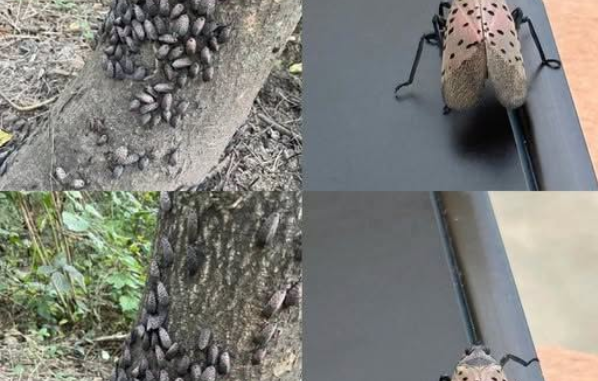
At first glance, the spotted lanternfly can look surprisingly beautiful. Its gray spotted wings and flashes of bright red make it easy to mistake for an interesting native insect.
But appearances can be deceiving.
The spotted lanternfly (Lycorma delicatula) is an invasive insect that has become a serious agricultural and environmental concern in parts of the United States.
It doesn’t bite or sting people, but large populations can stress certain plants and create messy conditions around homes, gardens, orchards, and vineyards.
If you encounter one, knowing how to identify it—and what to do next—can help limit its spread.
Why Is the Spotted Lanternfly a Problem?
Unlike caterpillars or beetles that chew holes through leaves, spotted lanternflies feed by piercing plant tissue and consuming sap.
They can gather in large numbers on trees, vines, and other plants.
Heavy feeding can stress susceptible plants, particularly when infestations are severe.
Grapevines are an important concern because large spotted lanternfly populations can affect vineyards and agricultural production.
However, it’s important to avoid exaggeration.
A spotted lanternfly landing on a healthy tree doesn’t mean the tree is automatically going to die. The level of damage depends on the plant species, infestation size, environmental conditions, and other factors.
The Sticky Substance They Leave Behind
One of the most noticeable problems associated with spotted lanternflies is honeydew.
Honeydew is a sugary waste product produced as the insects feed.
When large numbers gather in one area, honeydew can coat:
- Leaves
- Tree trunks
- Cars
- Outdoor furniture
- Decks
- Sidewalks
- Objects underneath infested trees
The sticky coating can become frustrating for homeowners.
But another problem can follow.
Why Everything Can Turn Black
Honeydew creates favorable conditions for fungi commonly called sooty mold.
Sooty mold forms a dark coating on surfaces where honeydew accumulates.
It can make leaves, branches, patios, and other objects appear as though they’ve been covered in black powder.
Heavy growth on leaves can interfere with the amount of sunlight reaching their surfaces, potentially affecting photosynthesis.
Sooty mold itself isn’t usually attacking the plant tissue directly. The underlying problem is the insect infestation producing large quantities of honeydew.
Controlling the insects can therefore help reduce the source of the problem.
How to Recognize a Spotted Lanternfly
Identification can be confusing because spotted lanternflies change dramatically as they develop.
Early Nymphs
Young nymphs are small, wingless insects.
They’re primarily black with noticeable white spots.
Because of their small size, they can be easy to overlook.
Later Nymphs
As they mature, their appearance becomes much more distinctive.
Later-stage nymphs develop bright red coloring along with black and white markings.
This red-and-black stage can be particularly noticeable on tree trunks and plants.
Adults
Adult spotted lanternflies are approximately an inch long.
When resting, their forewings are generally grayish with dark spots.
When they open their wings or jump, bright red sections of the hindwings become visible.
That sudden flash of red is one of their most recognizable characteristics.
Don’t Forget the Egg Masses
Adults aren’t the only stage homeowners should learn to recognize.
Spotted lanternflies lay egg masses on many hard surfaces.
These can include:
- Trees
- Rocks
- Fences
- Outdoor furniture
- Vehicles
- Trailers
- Firewood
- Other outdoor objects
Fresh egg masses can have a gray, mud-like coating.
Older masses may look dry, cracked, or weathered.
Because eggs can be transported on vehicles and outdoor materials, inspecting objects before moving them from an infested area can help reduce accidental spread.
Their Favorite Tree
The spotted lanternfly is strongly associated with the tree of heaven (Ailanthus altissima).
Interestingly, tree of heaven is itself an invasive plant in the United States.
However, spotted lanternflies aren’t limited to this species.
They can feed on many plants, including grapevines and various trees.
Finding tree of heaven on your property may therefore be useful when monitoring for lanternflies.
But removing the tree isn’t always as simple as cutting it down.
Tree of heaven can aggressively produce new shoots after improper cutting. Property owners considering removal may want guidance from local extension services or invasive-plant specialists.
What Should You Do If You Find One?
Recommendations depend heavily on your location.
Spotted lanternflies are already established in some areas, while authorities are still trying to prevent establishment in others.
If you see a suspected spotted lanternfly, take a clear photograph if possible.
Then check the guidance from your state’s agriculture department or local extension service.
In areas where officials request reports, submitting the photograph and location can help authorities monitor the insect’s spread.
Removing Individual Lanternflies
Where local authorities recommend destroying spotted lanternflies, individual insects can be physically removed.
You don’t need complicated equipment for a few insects.
The more important goal is preventing large populations and avoiding accidentally transporting them into new areas.
Follow local recommendations because management advice may change depending on whether the insect is already established where you live.
Scraping Egg Masses
Removing egg masses can help reduce the number of insects that hatch later.
If you find a confirmed spotted lanternfly egg mass, local authorities may recommend scraping it from the surface and destroying the eggs according to regional instructions.
Don’t simply scrape an egg mass onto the ground and assume the problem has been solved.
Some eggs may remain viable.
Check your local agriculture or extension guidance for the recommended disposal method.
Be Careful With Sticky Traps
Sticky bands placed around tree trunks can capture spotted lanternfly nymphs as they climb.
However, there’s an important downside.
Unprotected sticky materials can accidentally trap birds, small mammals, beneficial insects, and other wildlife.
If sticky bands are recommended in your area, wildlife-protective barriers or other safer designs should be used.
Another option is a properly designed circle trap, which can capture climbing lanternflies while reducing risks to other animals.
Don’t Automatically Reach for Pesticides
Finding an invasive insect can make homeowners want to spray everything immediately.
That’s rarely the best approach.
Broad or inappropriate pesticide use can harm pollinators and other beneficial insects without solving the underlying infestation.
Some insecticides also have specific application requirements.
If you’re dealing with a significant infestation, contact your local extension service or a licensed pest-management professional for guidance.
Follow pesticide labels exactly whenever such products are used.
Do Spotted Lanternflies Bite People?
No.
Spotted lanternflies aren’t known for biting or stinging humans.
Their specialized mouthparts are designed for feeding on plants.
They’re primarily an agricultural and plant-health concern rather than a direct threat to people.
Can They Fly Long Distances?
Adults can fly or glide short distances, but human transportation plays an important role in their spread.
Egg masses can be laid on vehicles, trailers, outdoor equipment, firewood, and other objects that people move from one location to another.
That’s why checking outdoor items can be so important when traveling from an infested area.
An insect doesn’t need to fly hundreds of miles if it can hitch a ride.
Should You Report One?
It depends on where you live.
In an area where spotted lanternflies haven’t been widely established, a confirmed sighting may be particularly important.
State agriculture agencies often provide current maps, reporting instructions, and identification resources.
If you’re uncertain whether you’ve actually found a spotted lanternfly, take a photograph before destroying it when practical.
That can make identification easier and help avoid unnecessarily killing harmless native insects.
Protecting Your Garden Without Panicking
Finding a spotted lanternfly doesn’t mean your entire garden is doomed.
The insect is a legitimate invasive pest, particularly for certain crops and plants, but responsible management is more useful than panic.
Learn to recognize adults, nymphs, and egg masses.
Inspect outdoor objects before transporting them.
Follow local reporting recommendations.
Use wildlife-safe control methods.
And avoid unnecessary pesticide applications.
Final Thoughts
The spotted lanternfly’s colorful wings make it memorable, but this is one insect that shouldn’t simply be welcomed into the garden.
Large populations can feed heavily on plants, produce significant amounts of sticky honeydew, and contribute to sooty mold growth.
The biggest concern is preventing the insect from continuing to spread into new regions and protecting vulnerable agricultural crops.
If you think you’ve found one, photograph it, confirm the identification, and check your state or local agriculture authority’s current recommendations.
There’s no need to panic.
Awareness, early identification, responsible control, and preventing accidental transportation are much more effective.
Leave a Reply