
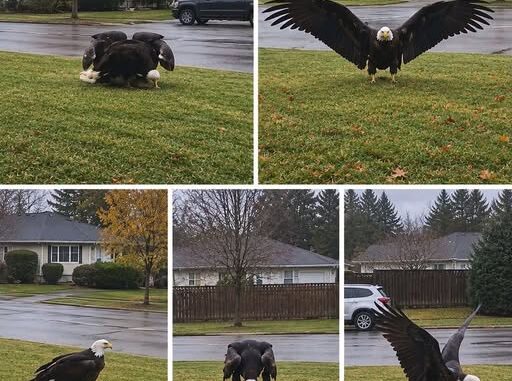
An unusual wildlife encounter near Brownsville, Texas, has captured attention and sparked plenty of conversation about the remarkable size and variety of birds that can be found in the region.
According to the circulating account, hikers encountered an exceptionally large eagle during an outing near the U.S.–Mexico border. Descriptions of the bird quickly turned the encounter into a story of mystery and wonder, with some witnesses claiming that its wingspan appeared far larger than that of a typical eagle.
However, extraordinary descriptions can be difficult to evaluate without photographs, measurements, and examination by qualified wildlife professionals. For that reason, the most intriguing claims surrounding the bird should be viewed as unverified until reliable evidence becomes available.
An Unexpected Encounter in the Texas Outdoors
Brownsville and the surrounding Rio Grande Valley are known for their diverse wildlife and important natural habitats. The area provides opportunities to observe numerous species of birds, making it a popular destination for birdwatchers, photographers, hikers, and researchers.
The reported eagle encounter began as an otherwise ordinary outdoor excursion. Hikers allegedly noticed a very large bird and initially struggled to determine exactly what they were seeing.
Some descriptions portrayed the bird as unusually imposing, with dark feathers, a powerful body, and an impressive wingspan.
One witness reportedly compared its appearance to something from another era, describing the bird as appearing almost ancient.
Such descriptions can naturally create excitement, particularly when an animal appears much larger than expected. Yet visual estimates made in the field can sometimes be misleading. Distance, perspective, lighting, and the angle of a bird’s wings can make an animal appear significantly larger than it actually is.
Why Size Estimates Can Be Difficult
Bird size is generally evaluated using measurable characteristics rather than visual impressions alone.
For large birds, researchers may record wingspan, body length, weight, wing shape, feather characteristics, and other physical features. These measurements can then be compared with established information about known species.
A claim of a wingspan approaching 10 feet would therefore require particularly careful documentation before it could be considered evidence of something scientifically unusual.
Photographs can provide an initial point of reference, but even photographs have limitations. Without a known object nearby for scale, estimating the actual size of an animal from a single image can be surprisingly difficult.
This is one reason wildlife researchers rely on multiple forms of evidence when investigating unusual animal reports.
Could It Be an Unknown Species?
Stories about exceptionally large animals often lead to speculation about undiscovered species or creatures believed to have disappeared from the wild.
That possibility makes for an interesting question, but scientists would require substantial evidence before reaching such a conclusion.
An unfamiliar-looking bird could potentially be an uncommon species, an individual with unusual characteristics, or simply a familiar species viewed under unusual circumstances.
Genetic testing, detailed physical examination, photographs, measurements, and comparisons with museum and scientific records could all help determine its identity if a genuine specimen were available for study.
Until that evidence exists, claims that the bird represents a previously unknown species or a species once thought extinct remain speculation.
The Importance of Wildlife Conservation
Regardless of the story surrounding the bird, unusual wildlife encounters provide an opportunity to highlight the importance of protecting natural habitats.
The Rio Grande Valley contains a wide range of ecosystems that support birds, mammals, reptiles, insects, and countless other organisms. Habitat loss, development, environmental changes, and human activity can all affect wildlife populations.
Large birds in particular require suitable areas for feeding, nesting, and shelter. Protecting those environments benefits not only individual animals but entire ecosystems.
Wildlife organizations also emphasize the importance of observing wild animals responsibly. Approaching, feeding, chasing, or attempting to capture an animal without proper authorization can put both people and wildlife at risk.
A Reminder That Nature Can Still Surprise Us
Modern technology has made it easier than ever to document wildlife. High-resolution cameras, trail cameras, drones, and other equipment allow researchers and the public to observe animals in ways that would have been difficult only a few decades ago.
Yet nature continues to produce moments that surprise people.
A bird appearing unexpectedly overhead, a rare migration event, or an unusual animal behavior can turn an ordinary afternoon outdoors into a memorable experience.
That sense of discovery is one of the reasons wildlife observation remains so popular.
At the same time, curiosity is most valuable when it is paired with careful observation. Extraordinary stories deserve extraordinary evidence, particularly when they challenge what is already known about a species.
What Would Confirm the Story?
If the Brownsville eagle is genuinely as unusual as some reports suggest, several pieces of evidence could help clarify the situation.
Researchers would likely want reliable measurements of the bird’s wingspan and body size, detailed photographs from multiple angles, information about its physical condition, and, where appropriate, biological or genetic testing.
Experts could then compare those findings with established records for known eagle and raptor species.
Such an investigation could determine whether the animal is simply an unusually large individual of a known species or whether there is another explanation for its unusual appearance.
Until those steps are completed and credible findings are made public, the most responsible approach is to treat the extraordinary details as an intriguing wildlife report rather than a confirmed scientific discovery.
The Wonder Behind the Story
Whether the Brownsville encounter eventually turns out to involve an unusually large known bird or something else entirely, the story illustrates why people remain fascinated by the natural world.
Wildlife can challenge our expectations without necessarily being mysterious or unexplained. Sometimes an unusual observation simply encourages researchers to look more closely.
For the public, these encounters can also inspire greater interest in conservation and responsible wildlife observation.
Nature does not need to be extraordinary in order to be remarkable. Even familiar species can reveal surprising behaviors, adaptations, and individual differences when observed closely.
The reported giant eagle may therefore be best understood as a reminder of that curiosity.
Before extraordinary claims can become scientific discoveries, they must be supported by evidence. But the desire to investigate, observe, and understand unusual wildlife is valuable in itself.
Leave a Reply