
Sometimes, a photograph can tell a completely different story depending on how someone looks at it. An ordinary moment captured on camera can suddenly become a mystery when an unusual shadow, unexpected shape, or confusing angle catches the attention of viewers.
That is exactly what makes certain viral photographs so fascinating.
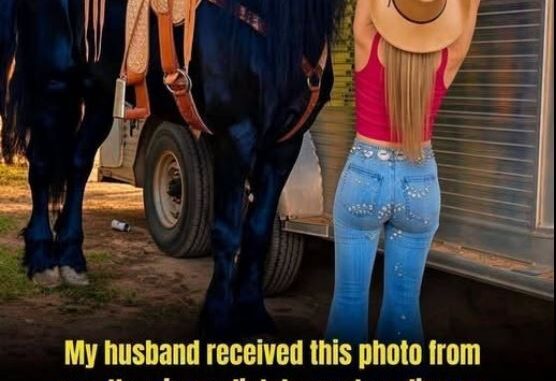
One widely discussed image reportedly shows a woman standing beside a beautiful black horse, reaching toward its face. At first glance, the scene appears peaceful and ordinary. The woman seems focused on the animal, while the horse stands close beside her.
However, some viewers noticed something unusual around the woman’s back and waist.
A dark shape appears to resemble a pair of human arms wrapped around her body. Once people notice this detail, it can become difficult to look at the photograph without seeing the same unusual shape.
Some interpretations even suggest that another person might be standing behind the woman.
But is there really someone hiding in the picture?
According to the explanation accompanying the image, the mysterious shape is more likely the result of overlapping parts of the horse, shadows, and camera perspective.
The photograph provides an interesting example of how easily the human brain can misinterpret visual information.
1. The Photograph That Makes People Look Twice
The most interesting photographs are not always those featuring extraordinary events.
Sometimes, an ordinary picture becomes popular because it contains a visual detail that people cannot immediately understand.
In this particular image, the woman’s position beside the horse creates an unusual arrangement of shapes.
The dark color of the animal makes it difficult to distinguish certain details, particularly where the horse’s body overlaps with the woman’s clothing and silhouette.
As viewers examine the photograph, their attention naturally moves toward the area around her waist and back.
What initially appears to be part of the horse’s body may resemble something entirely different.
Some people interpret the shape as another person’s arms.
Others believe it is simply a combination of the horse’s outline and surrounding shadows.
This disagreement is what makes the image so intriguing.
Without examining the photograph carefully, it is easy to jump to conclusions based on the first impression.
2. What Is the Hidden Detail?
The unusual shape reportedly appears behind the woman, close to the area where her back and waist meet the horse’s body.
Because the horse is black, its outline can blend into darker parts of the photograph.
When two objects overlap, their boundaries may become difficult to distinguish.
The woman’s clothing, the horse’s body, and the surrounding shadows may combine to create an unexpected visual pattern.
The result is an illusion that resembles a human figure.
However, recognizing a familiar shape does not necessarily mean that the shape represents the object we think we see.
Our brains constantly interpret incomplete visual information.
When a photograph contains unusual lighting or confusing outlines, the brain may automatically fill in missing details.
That is why some viewers may see human arms while others see nothing unusual.
3. The Science Behind the Optical Illusion: Pareidolia
There is a scientific term for the tendency to recognize familiar patterns in random or ambiguous images.
It is called pareidolia.
Pareidolia occurs when the human brain identifies recognizable objects, faces, or figures in visual information that does not necessarily contain those things.
A common example is seeing a face in the clouds.
Someone might look at a cloudy sky and notice what appears to be a smiling face. Another person looking at exactly the same clouds may see an animal or simply an unusual arrangement of shapes.
The clouds have not changed.
Only the interpretation has changed.
Pareidolia also explains why people sometimes see faces in electrical outlets, animals in rock formations, or human figures in shadows.
The brain is naturally designed to recognize patterns quickly.
This ability helps us understand the world, but it can occasionally lead to mistaken interpretations.
In photographs, the effect can become even stronger when objects overlap or when lighting makes certain details difficult to distinguish.
4. Why Dark Horses Can Make Visual Illusions More Convincing
The horse’s dark coat may play an important role in the confusion surrounding the photograph.
Black and very dark surfaces can make it difficult to identify boundaries when lighting is limited.
If a dark animal stands close to someone wearing similarly colored clothing, their outlines may visually merge.
This can create the impression that one object is connected to another.
The position of the camera also matters.
A photograph captures a three-dimensional scene from a single viewpoint.
Objects that are physically separate can appear connected when viewed from a particular angle.
For example, a horse’s leg may appear to extend from a person’s body, or a shadow may look like an additional object.
These effects are common in photography and do not necessarily indicate that anything unusual is happening.
5. How Captions Can Change What We See
Another fascinating aspect of viral photographs is the influence of captions.
Imagine looking at an unfamiliar picture without any explanation.
You might notice the woman and the horse, appreciate the setting, and continue scrolling.
Now imagine seeing a caption suggesting that another person is secretly standing behind the woman.
Suddenly, your attention moves toward the darker areas of the photograph.
You begin searching for arms, hands, clothing, or other signs of another person.
This is an example of how expectations can influence perception.
Once someone suggests a particular interpretation, the brain may become more likely to recognize shapes that support that idea.
This does not mean viewers are deliberately imagining things.
It simply demonstrates how powerful suggestions can be when visual information is unclear.
For this reason, viral captions should not automatically be treated as reliable explanations of what a photograph shows.
6. Does the Photograph Prove a Hidden Relationship?
Some versions of the story reportedly connect the image to a dramatic relationship situation involving a possible confrontation between a woman and her husband.
However, the available account does not provide independently verified evidence that such a confrontation occurred.
There is also no reliable information establishing that another man was holding the woman in the photograph.
A photograph alone cannot confirm the personal circumstances of the people shown.
It cannot reliably establish someone’s intentions, relationship history, or private conversations.
Even if an image appears to show something unusual, additional evidence is needed before making serious claims about real people.
This is particularly important when stories involve marriage, accusations of dishonesty, or possible betrayal.
A dramatic caption may attract attention, but it should never replace factual investigation.
The most responsible interpretation is to separate what can actually be observed from what someone claims the photograph means.
7. How to Examine an Optical Illusion More Carefully
If you encounter a photograph that appears to contain a hidden figure or mysterious object, there are several ways to examine it more objectively.
Look at the entire image first.
Instead of immediately focusing on the suspicious area, examine the full scene. Identify the positions of the people, animals, objects, and visible shadows.
Follow the outlines.
Try to trace where the horse’s body begins and ends. Look carefully at the woman’s clothing and the shapes created by overlapping objects.
Consider the lighting.
Shadows can create unusual patterns, especially when several dark objects appear close together.
Change your viewing distance.
Sometimes, stepping back from a photograph makes the overall arrangement easier to understand.
Avoid relying entirely on captions.
Read the image independently before considering the explanation provided by someone else.
Look for additional evidence.
If a photograph is connected to a serious news claim, search for reliable reporting rather than relying on anonymous social media descriptions.
These simple steps can help prevent misunderstandings.
8. Why Optical Illusions Become So Popular Online
Visual puzzles have a special appeal because they encourage people to participate.
Unlike ordinary news stories, an optical illusion asks viewers to do something.
They must look closely, identify unusual shapes, compare interpretations, and decide what they believe is happening.
This interactive quality makes such photographs particularly attractive on social media.
People often share them with friends and family, asking whether others can see the same hidden detail.
Comments can quickly develop into discussions, with different viewers offering competing explanations.
Some people notice the illusion immediately, while others need several attempts.
The combination of curiosity, surprise, and disagreement helps explain why visual puzzles can spread rapidly.
However, popularity should not be confused with accuracy.
A photograph can become widely shared even when the story attached to it has not been verified.
9. The Difference Between What We See and What Is Actually There
One of the most important lessons from this image is that human perception is not always perfect.
We often believe that seeing something means understanding it.
But photographs can be misleading because they freeze a moment, remove movement, and present objects from only one perspective.
A shadow that looks like a person in one frame may become obviously recognizable as part of an animal when viewed from another angle.
Similarly, an object that appears unusually shaped in a photograph may look completely ordinary in person.
This is why careful observation matters.
Rather than accepting the first explanation that comes to mind, it is better to consider alternative possibilities.
The goal is not to dismiss every unusual photograph.
It is to distinguish genuine evidence from visual confusion and unsupported storytelling.
Final Thoughts: Sometimes the Hidden Detail Is an Illusion
The photograph of a woman standing beside a black horse offers an entertaining example of how easily the human brain can misinterpret shapes and shadows.
What some viewers believe resembles another person’s arms may actually be the result of overlapping outlines, dark surfaces, and camera perspective.
The phenomenon of pareidolia helps explain why different people can look at the same photograph and reach completely different conclusions.
The accompanying relationship story also demonstrates why viral captions should be approached with caution.
Without independent evidence, claims about a hidden person or a dramatic confrontation remain unverified.
The next time you encounter a photograph that appears to contain a mysterious figure, take a moment to examine the details before deciding what you see.
Look at the lighting, follow the outlines, and consider how the camera angle may have changed the appearance of the scene.
Sometimes, the most surprising discovery is not a hidden person or a shocking secret.
It is simply how creatively the human brain interprets an ordinary picture.
Leave a Reply