
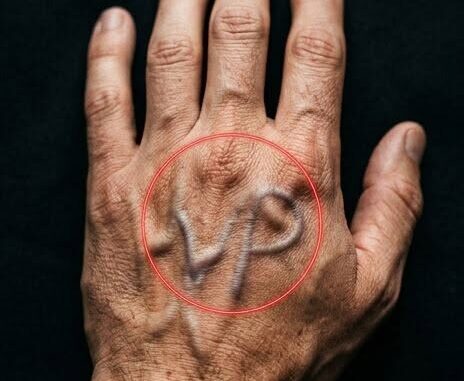
The first thing anyone noticed about the hand was the mark.
It wasn’t ink. It wasn’t dirt. It wasn’t something that could be washed away with soap or hidden under a sleeve. It sat there, embedded in the skin on the back of the hand, raised slightly like a scar and yet too smooth, too deliberate to be the result of injury. The shape itself looked almost like a symbol—something between a letter and a design, curved lines twisting into a form that felt intentional, meaningful, and unsettling.
At first glance, it might have been dismissed as a burn or a strange birthmark. But the more you looked at it, the more it refused to be ordinary.
The man who bore it—let’s call him Adrian—had lived most of his life without anything unusual about his appearance. He had the kind of hands people never noticed: practical, slightly rough from everyday use, marked only by the normal signs of time. There was nothing remarkable about him, nothing that drew attention in a crowd. He preferred it that way. His life had always been built around routine, predictability, and the quiet comfort of anonymity.
That changed the morning he woke up and found the mark.
At first, Adrian thought he had simply slept on his hand wrong. There was a faint soreness, a tightness in the skin that made him flex his fingers slowly. When he turned his hand over, expecting to see a crease or maybe a minor bruise, he froze.
The symbol was already there.
It wasn’t forming. It wasn’t faint. It was complete—as if it had always existed and he had simply failed to notice it before. But that wasn’t possible. Adrian was observant, detail-oriented. He would have seen something like that.
He rubbed at it, instinctively, the way anyone would when faced with something unfamiliar on their skin. Nothing happened. The mark didn’t smear or fade. It didn’t hurt when he touched it, but it didn’t feel entirely like his skin either. There was a slight difference in texture, a subtle resistance, as if he were touching something layered just beneath the surface.
He went to the sink, turned on the water, and scrubbed.
Still nothing.
The mark remained.
For most people, this would have been a moment of mild confusion, maybe a quick search online, perhaps a visit to a doctor if it persisted. But Adrian felt something else—something deeper than curiosity. A quiet, creeping sense that this wasn’t random.
That it meant something.
The day went on, but the mark followed him in every movement. At work, he found himself glancing at his hand again and again, half expecting the symbol to shift or disappear. It didn’t. If anything, it seemed more defined as the hours passed, the lines clearer, the shape sharper.
His concentration slipped. Conversations blurred. Every ordinary task felt slightly off, as if the world had tilted just enough to make everything unfamiliar.
By the time he returned home, the unease had grown into something harder to ignore.
That night, he dreamed.
In the dream, he stood in a place he didn’t recognize—a wide, open expanse under a dark sky. There were no buildings, no landmarks, just an endless stretch of ground that seemed to pulse faintly with light. The air felt heavy, charged, like the moment before a storm.
And there, in front of him, was the symbol.
Not on his hand this time, but enormous, carved into the ground, glowing faintly as if lit from within. The same curves, the same lines, but magnified beyond comprehension.
He stepped closer.
As he did, the symbol seemed to respond, the light intensifying, the edges shifting ever so slightly. It wasn’t static. It was alive in a way he couldn’t fully understand.
Then he heard something.
A sound—not quite a voice, but something close. It wasn’t coming from any direction he could identify. It felt like it was inside him, resonating rather than speaking.
He woke up with a start, his heart racing.
The room was quiet. The world was normal again.
But the mark was still there.
Over the next few days, Adrian’s life began to change in small, almost imperceptible ways. It started with sensations—brief, fleeting moments where he felt something he couldn’t explain. A pull in a certain direction. A sudden awareness of things he had never noticed before. Patterns in the way people moved, the way light fell across surfaces, the way sounds layered together.
The mark seemed to react during these moments. It would grow warmer, almost as if responding to whatever he was experiencing.
He tried to ignore it.
He told himself it was stress, imagination, the result of thinking too much about something that didn’t have a real explanation. But deep down, he knew that wasn’t true.
One evening, as the sun dipped below the horizon and the world softened into twilight, Adrian found himself walking without a clear destination. He hadn’t planned to leave his apartment, but something had drawn him out—a quiet, persistent urge he couldn’t quite resist.
He walked through streets he knew well, yet they felt different, as if he were seeing them for the first time. Every corner held a strange familiarity, like a memory just out of reach.
Eventually, he stopped.
In front of him stood an old building he had passed countless times but never entered. It was unremarkable in every way—aged brick, narrow windows, a door that blended into the facade. And yet, in that moment, it felt significant.
The mark on his hand grew warm.
He raised his hand, staring at the symbol.
For a brief second, it seemed to shift.
Not physically, not in a way he could prove, but in his perception of it. The lines felt deeper, more complex, as if there were layers hidden within the design.
Without fully understanding why, Adrian reached out and touched the door.
The moment his fingers made contact, a strange sensation moved through him—like a current, subtle but undeniable. The world seemed to hold its breath.
And then, slowly, the door opened.
What he found inside wasn’t what he expected.
The space beyond the door didn’t match the exterior of the building. It was larger, impossibly so, stretching out into a dimly lit interior filled with shapes and structures he couldn’t immediately identify. The air felt different—thicker, charged with the same energy he had felt in his dream.
He stepped inside.
The door closed behind him without a sound.
For a moment, he just stood there, letting his eyes adjust, his mind trying to make sense of what he was seeing. The space was filled with symbols—on the walls, the floor, even suspended in the air as faint traces of light.
And among them, he saw it.
The same symbol that marked his hand.
Not just once, but repeated in different forms, different sizes, woven into a larger pattern that seemed to connect everything in the room.
He wasn’t alone.
At the far end of the space, a figure stood, partially obscured by shadow. They didn’t move at first, but Adrian could feel their presence, steady and aware.
“Finally,” the figure said.
The voice was calm, measured, carrying a weight that suggested understanding far beyond Adrian’s own.
“You found your way.”
Adrian swallowed, his mind racing.
“I didn’t mean to,” he said, his voice quieter than he intended.
The figure stepped forward, the light revealing more of their face—though not enough to fully identify them. There was something familiar about them, but Adrian couldn’t place it.
“You did,” the figure replied. “Whether you realize it or not.”
Adrian looked down at his hand.
“This… this thing,” he said. “What is it?”
The figure’s gaze followed his, settling on the mark.
“It’s a beginning,” they said.
“A beginning of what?”
The figure paused, as if considering how to answer.
“Of seeing,” they said finally. “Of understanding what most people never notice.”
Adrian shook his head.
“That doesn’t explain anything.”
“It doesn’t need to. Not yet.”
The frustration bubbled up, sharp and immediate.
“I didn’t ask for this,” Adrian said. “I just woke up one day and it was there.”
The figure nodded.
“None of us ask,” they said. “But some of us are chosen.”
Adrian let out a short, disbelieving laugh.
“Chosen? For what?”
The figure didn’t answer right away. Instead, they stepped closer, their presence steady, almost grounding despite the strangeness of everything else.
“For awareness,” they said. “For the ability to see patterns where others see randomness. To recognize what lies beneath the surface.”
Adrian looked around the room again—the symbols, the faint glow, the impossible architecture.
“This isn’t normal,” he said.
“No,” the figure agreed. “It isn’t.”
There was a long pause.
“And that’s the point.”
Over time, Adrian began to understand.
Not all at once, not in a single revelation, but in fragments—moments of clarity that built on each other. The mark wasn’t just a symbol. It was a key, a connection to something larger, something that existed just beyond the edges of ordinary perception.
The world, he learned, wasn’t as simple as it appeared.
There were layers—patterns and structures that most people moved through without ever noticing. Systems that guided events, influenced outcomes, shaped the flow of life in subtle but significant ways.
The mark allowed him to see those layers.
At first, it was overwhelming.
Everywhere he looked, there was more—more detail, more meaning, more complexity than he had ever imagined. It was like stepping into a version of reality that had always been there but had remained hidden.
But with time, he adapted.
He learned to focus, to filter, to choose what to pay attention to and what to let fade into the background. The mark became less of a mystery and more of a tool—something he could use, something he could understand.
It changed him.
Not in a dramatic, outward way, but in the quiet, internal sense of how he experienced the world. He became more aware, more present, more attuned to the subtle shifts and patterns that shaped his life.
The ordinary no longer felt quite so ordinary.
And yet, despite everything he had learned, one question remained.
Why him?
It was a question he asked often, sometimes out loud, sometimes only in his thoughts. The figure never gave a direct answer.
“Does it matter?” they would say.
For a long time, Adrian thought it did.
He wanted a reason, a clear explanation, something that would anchor the experience in logic and certainty. But the more he learned, the more he began to realize that not everything needed to be explained in that way.
Some things simply were.
The mark wasn’t a burden.
It wasn’t a curse or a mistake.
It was an invitation.
An opening.
A chance to see the world differently.
And in the end, that was enough.
The hand was still the same hand—familiar, human, grounded in the everyday reality of life. But the mark had changed what that hand could do, what it could perceive, what it could connect to.
It was a reminder.
That there is always more beneath the surface.
That even the smallest detail—a shape, a line, a mark on the skin—can hold meaning beyond what we first imagine.
And that sometimes, the most profound changes begin in the quietest, most unexpected ways.
Leave a Reply