
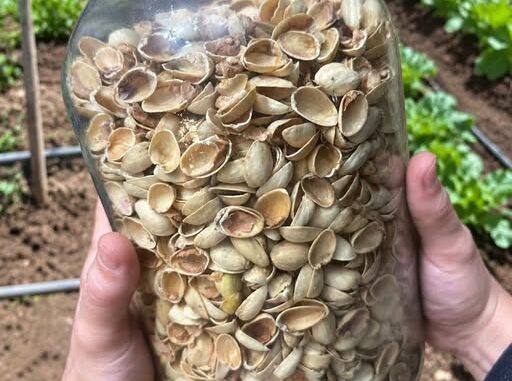
Pistachios are a popular snack, but the shells left behind usually end up in the trash. With a little preparation, however, those shells can be reused around the garden in several practical ways.
From adding texture to compost to creating a coarse soil amendment or mulch, pistachio shells can become part of a more sustainable gardening routine. The key is to prepare them properly and understand what they can—and cannot—do for your plants.
Start by Cleaning the Shells
Before using pistachio shells in the garden, remove any remaining pieces of nut or food residue.
Salted pistachio shells should be treated with particular care. Large amounts of salt can be harmful to plants and may affect soil conditions, so rinsing the shells thoroughly and allowing them to dry completely is a sensible precaution.
Once clean, spread the shells somewhere dry and allow them to air-dry before crushing them.
Crushing Pistachio Shells
The shells can be used in different sizes depending on the gardening purpose.
For soil applications, they can be broken into smaller pieces or crushed into a coarse powder. A sturdy bag and a mallet can be used for small quantities, while a suitable grinder may be more convenient for larger amounts.
There is no need to turn every shell into an extremely fine powder. In many situations, small pieces can provide useful texture without requiring extensive processing.
Always use appropriate protection when crushing hard materials to avoid flying fragments or dust.
Can Pistachio Shells Improve Soil?
Crushed pistachio shells can contribute organic material and physical structure to soil, but they should not be considered a replacement for compost or a complete fertilizer.
Large pieces can help create physical spaces within dense soil, potentially improving drainage and reducing compaction when incorporated appropriately. However, pistachio shells are relatively slow to break down, so their effects are gradual.
For heavy or compacted soil, gardeners generally get better results by combining organic matter such as finished compost with other appropriate soil amendments rather than relying on shells alone.
Using Shells as a Garden Mulch
Another simple option is to use crushed shells as a surface covering around suitable plants.
A layer of coarse shell pieces can help cover exposed soil and may reduce direct evaporation from the soil surface. Mulch can also help moderate soil temperature and reduce the amount of bare ground available for some weeds.
Pistachio shells have a relatively rough texture, which may make the surface less comfortable for certain soft-bodied garden pests such as slugs and snails to cross.
However, this should not be treated as a guaranteed pest-control method. Garden pests can find ways around barriers, and effective control often requires a combination of strategies.
Adding Pistachio Shells to Compost
Pistachio shells can also be incorporated into a compost system.
Because they are a dry, carbon-containing material, they can contribute to the balance of a compost pile. However, whole shells break down slowly, so crushing them first can help increase their surface area.
Small amounts mixed into compost are generally more practical than adding a large quantity at once.
A healthy compost pile benefits from a mixture of materials, including moisture-rich green materials and carbon-rich brown materials. Pistachio shells can form a small part of that overall mix.
What About Nutrients?
It is sometimes claimed that pistachio shell powder is a mineral-rich fertilizer capable of dramatically improving plant growth. That description can be misleading.
Pistachio shells contain organic material and minerals, but they are not a complete plant fertilizer. Their nutrients are not immediately available to plants in the same way that nutrients in a formulated fertilizer can be.
Instead, their potential value comes primarily from their physical properties and their gradual decomposition.
For plants that need specific nutrients, a soil test and an appropriate fertilizer or soil amendment are more reliable options.
Why Slow Decomposition Can Be Useful
One characteristic of pistachio shells is that they are hard and relatively slow to decompose.
Although this means gardeners should not expect immediate results, slow decomposition can be useful in situations where a longer-lasting material is desired.
Crushed shells can remain in the soil for an extended period while gradually becoming incorporated into the surrounding organic material.
This makes them quite different from quickly decomposing materials such as grass clippings or soft vegetable scraps.
Using Pistachio Shells Around Potted Plants
Gardeners may also experiment with small amounts of crushed shells in outdoor containers.
Because containers have limited space, however, moderation is important. A thick layer of shell material can interfere with water movement rather than improving it, particularly if the material becomes compacted.
For potted plants, commercially prepared potting mixes are generally designed to provide the appropriate balance of drainage, moisture retention, and aeration.
If shells are used, they are better treated as a minor supplemental material rather than the main component of the growing medium.
Avoid Using Large Quantities at Once
One of the most important principles when reusing household materials in the garden is moderation.
Adding a large quantity of unfamiliar material to soil can change its physical characteristics and potentially create unwanted conditions.
Pistachio shells are particularly slow to break down, so gardeners should avoid assuming that more is automatically better.
Start with a small amount and observe how the soil responds over time.
A Simple Way to Reuse Kitchen Waste
Perhaps the biggest advantage of pistachio shells is simply that they can be reused instead of immediately discarded.
Gardening already offers many opportunities to turn household leftovers into useful resources. Vegetable scraps can become compost, fallen leaves can become mulch, and certain food byproducts can be repurposed when used appropriately.
Pistachio shells fit into this broader approach.
Rather than viewing every kitchen leftover as garbage, gardeners can consider whether it has a safe second use.
A More Sustainable Gardening Habit
Reusing materials can be an easy way to reduce household waste while making gardening more resource-conscious.
Pistachio shells will not transform poor soil overnight, and they should not be treated as a miracle gardening product. Their value is more practical: they can provide texture, contribute to compost, serve as a coarse mulch, and make use of a material that would otherwise be thrown away.
The best results come from combining them with established gardening practices such as adding finished compost, maintaining appropriate moisture, protecting soil with suitable mulch, and choosing amendments according to the needs of individual plants.
Final Thoughts
Pistachio shells may seem like ordinary kitchen waste, but they can have a second life in the garden.
After being cleaned, dried, and appropriately crushed, they can be used in small amounts as part of compost, mulch, or soil-management practices. Their slow decomposition means they work gradually rather than providing an immediate source of plant nutrition.
The important thing is to use them realistically. Pistachio shells are not a substitute for quality compost or balanced fertilizer, but they can be a useful addition to a broader approach to sustainable gardening.
Leave a Reply