
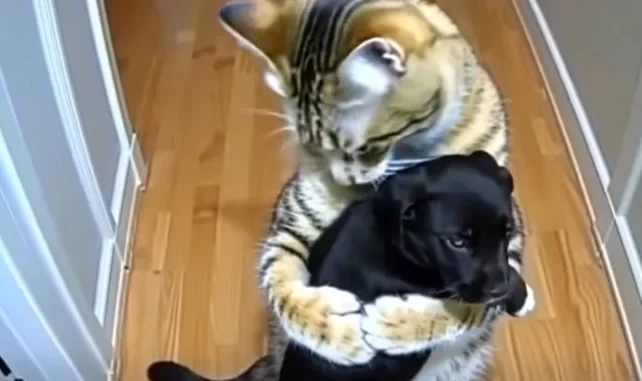
Some ordinary days turn into stories you never forget.
That happened when a family cat named Marsa began returning home with something completely unexpected: tiny puppies.
At first, no one understood where they were coming from or why Marsa seemed so determined to bring them inside.
The First Puppy
One afternoon, Marsa entered the house carrying a small puppy carefully in her mouth.
Instead of showing aggression, she placed it near her resting area and stayed close.
The puppy appeared tired but calm, and Marsa seemed unusually attentive.
It was strange enough once.
Then it happened again.
Over the following days, Marsa reportedly returned with more puppies, each time bringing them to the same safe area of the house.
Soon, several were sleeping together while the cat remained nearby.
Where Were They Coming From?
The family quickly became curious.
Cats sometimes move their own kittens or carry small animals, but bringing home multiple puppies was highly unusual.
The biggest question was simple:
Where had Marsa found them?
Rather than assuming the cat had “adopted” them in a human sense, the family decided to follow her route.
That led to a hidden area beyond the yard.
The Hidden Spot
Marsa moved through a gap near the fence and continued toward an overgrown area with tall grass and trees.
Eventually, more puppies were found sheltering in a concealed spot.
At that point, the strange behavior began to make more sense.
The cat had apparently discovered vulnerable young animals and had repeatedly carried some of them back toward a familiar, sheltered environment.
Exactly what motivated the behavior cannot be known with certainty, but animals sometimes display nurturing or protective responses toward young animals—even those of another species.
Getting the Puppies Help
Once the puppies were located, the safest next step was human intervention.
Young puppies can quickly become dehydrated, cold, or ill if separated from their mother or left without reliable care.
Animal welfare professionals or a veterinarian can check their condition, determine whether they need feeding or treatment, and help locate an owner or mother dog when possible.
In a real situation like this, handling the rescue carefully is far more important than assuming the animals are fine simply because another pet is watching over them.
Can Cats Really Care for Puppies?
Cross-species nurturing does happen.
Female cats, especially those with strong maternal behavior, may sometimes groom, lie beside, or even nurse young animals that are not kittens.
However, every case is different.
A cat showing interest in puppies does not automatically mean she can provide everything they need.
Puppies have different nutritional and medical requirements, which is why professional assessment is important.
Why the Story Feels So Powerful
What makes a story like this memorable is not simply the unusual image of a cat beside puppies.
It is the unexpected connection.
People often imagine cats and dogs as natural rivals, but real animal behavior is much more flexible.
Individual animals may form friendships, share sleeping areas, groom one another, or show protective behavior.
Marsa’s unusual actions became a reminder that animal behavior does not always fit simple stereotypes.
Final Thoughts
A cat repeatedly bringing home puppies would naturally raise plenty of questions.
Were they lost?
Was their mother nearby?
Were they healthy?
And why had the cat chosen to move them?
Those questions should always be answered with proper care rather than assumptions.
But there is still something remarkable about an animal responding to vulnerable young creatures in such an unexpected way.
What began as a confusing discovery became a story about instinct, curiosity, and the surprising relationships animals can form.
Sometimes the most memorable rescue stories begin with something as simple as a pet walking through the door carrying a mystery.
Leave a Reply