
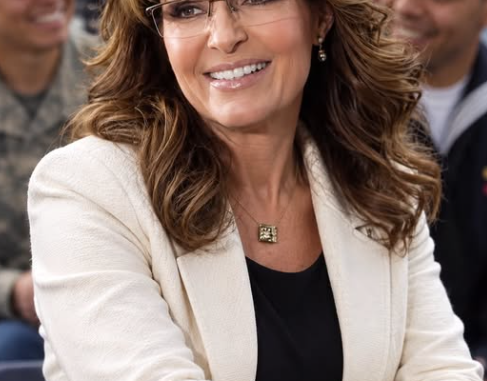
Sarah Palin has spent much of her public life in an environment where even small details can attract considerable attention.
As a former governor of Alaska, former vice-presidential candidate, author, commentator, and television personality, Palin is no stranger to being photographed and discussed.
That attention does not always focus on politics.
At times, something as simple as an outfit can become a topic of conversation, particularly when photographs spread quickly across social media.
When Fashion Becomes Part of the Conversation
For public figures, clothing can sometimes become more than a practical choice.
An outfit may be discussed in relation to a particular event, period of someone’s life, or public image. In Palin’s case, her recognizable style has been part of her public persona for years.
When new photographs appear online, viewers may immediately compare them with earlier images.
Some people see a change in style.
Others notice similarities with the way she dressed during previous stages of her career.
And some simply appreciate the look itself.
Social media can amplify all of these reactions within a matter of hours.
A Public Image Built Over Many Years
Palin first became widely known outside Alaska when she was selected as John McCain’s running mate in the 2008 presidential election.
Her appearance, speaking style, family life, and clothing were frequently analyzed throughout the campaign.
That level of attention helped establish a pattern that has continued long after the election ended.
Because Palin has remained active in public life, photographs of her can carry associations with different periods of her career.
An image that might seem ordinary when viewed in isolation can therefore remind people of earlier political campaigns, television appearances, interviews, or public events.
In that sense, the reaction is often about more than the clothing itself.
Social Media Changes How Images Are Interpreted
Traditional media once provided much of the context surrounding photographs.
Today, an image can appear on social media without an explanation of where it was taken, why the person was there, or what was happening before or after the photograph.
That can make a simple fashion choice appear much more significant than it actually was.
Comments and reposts can then add additional interpretations.
One person may describe an outfit as elegant.
Another may consider it unconventional.
Someone else may connect it to Palin’s political past.
The original photograph remains the same, but the meaning people attach to it can change dramatically depending on who is viewing it.
Fashion Does Not Have to Represent a Political Statement
Public figures sometimes use clothing deliberately to communicate something.
But that does not mean every outfit contains a hidden message.
People change their clothing preferences throughout their lives for many ordinary reasons.
Personal taste evolves.
Fashion trends change.
Different occasions call for different styles.
Comfort can become more important.
A person may simply see an outfit they like and decide to wear it.
That can be particularly easy to forget when the individual involved has a long history in public life.
For someone like Palin, viewers may instinctively search for a deeper meaning because they already associate her with politics and controversy.
But sometimes an outfit is simply an outfit.
The Evolution of Personal Style
Style naturally changes with age and circumstances.
Someone who dressed one way during their twenties may have very different preferences decades later.
Professional environments can influence clothing choices, as can travel, lifestyle, culture, and personal interests.
Public figures are not exceptions.
Palin’s career has taken her through government, political campaigns, publishing, television, speaking engagements, and other forms of media.
Each environment comes with different expectations.
Her current style therefore does not necessarily need to resemble the appearance associated with her earlier political career.
That evolution is perfectly ordinary.
Why Celebrity and Political Fashion Gets So Much Attention
Fashion and politics have crossed paths for decades.
The clothing choices of presidents, first ladies, politicians, actors, musicians, and other public figures are often discussed because appearance is an unavoidable part of public communication.
But the attention can sometimes become disproportionate.
A photograph may receive thousands of comments even though the person featured may have spent only a few minutes choosing what to wear.
That contrast highlights the difference between the experience of the individual and the experience of the audience.
For the person wearing the outfit, it may simply be another day.
For viewers, it can become a conversation about identity, personality, age, politics, or cultural expectations.
The Pressure of Being Constantly Photographed
Public figures rarely control every photograph taken of them.
Images can be captured at airports, restaurants, public events, meetings, conferences, or while walking between engagements.
A single frame may capture an unusual expression, an unexpected moment, or an outfit that looks different from what someone normally wears.
Once the image reaches social media, the audience can decide what the moment supposedly means.
That can create a strange situation in which a person becomes the subject of a large conversation without having intended to start one.
Moving Beyond Appearance
There is nothing wrong with discussing fashion, especially when a public figure has a recognizable personal style.
The problem begins when appearance becomes the primary measure of someone’s character or value.
A person’s clothing cannot tell us everything about their personality, beliefs, accomplishments, or private life.
For public figures with complicated histories, it can be tempting to interpret every detail through the lens of their past.
But people are capable of changing.
They can experiment with different styles.
They can adopt new interests.
They can simply enjoy clothing without making a political statement.
A Moment That Became Bigger Than It Needed to Be
The attention surrounding Sarah Palin’s recent appearance illustrates how quickly social media can transform an ordinary photograph into a larger conversation.
Some viewers will see a memorable fashion choice.
Others may use the image as an opportunity to revisit their opinions about Palin herself.
Both reactions are part of the modern social-media environment, where photographs can travel far beyond their original setting.
Yet the simplest explanation may also be the most accurate.
A public figure chose an outfit, appeared in front of cameras, and people noticed.
The rest was created by the audience.
Personal Style Is Allowed to Change
Perhaps the most useful takeaway is that personal style does not have to remain frozen in time.
People change as they move through different stages of life.
Their interests change.
Their priorities change.
Their wardrobes change.
Public figures deserve the same freedom as anyone else to experiment with how they present themselves.
For Sarah Palin, an outfit may attract more attention than it would for someone outside the public eye because of her long history in American politics and media.
But that additional attention does not necessarily make the clothing more meaningful.
Sometimes a fashion moment really is just a fashion moment.
And in an era when almost every photograph can become a debate, there is something refreshing about remembering that simple fact.
Leave a Reply